

France has been a center of artistic innovation for centuries. From the Renaissance to modern art, French artists have challenged norms and changed the way the world views art. Their influence spread across the globe, with movements such as Impressionism, Fauvism and Cubism playing a pivotal role.
In this article, we present the lives and works of some of the most prominent French artists whose legacy continues to drive contemporary art.
Edouard Manet and the Transition to Impressionism
In the second half of the 19th century, the Academics dominated European art, demanding the depiction of myth and religion. However, Édouard Manet (1832-1883) challenged these rules with works depicting scenes of the time and took an innovative approach. His Le Déjeuner sur l’herbe (Pastoral Luncheon, 1863) caused controversy because it challenged the established rules of art by depicting a nude woman in a modern setting.
Manet eschewed Impressionism by using soft brushstrokes and a variety of bright hues. Although he never fully embraced Impressionism, his views influenced the careers of artists such as Claude Monet and Pierre-Auguste Renoir.
Claude Monet and the essence of Impressionism
The outstanding representative of Impressionism was the painter Claude Monet (1840-1926). His Impressionist painting The Rising Sun (1872) gave its name to a movement that focused on the absorption of natural light and color.
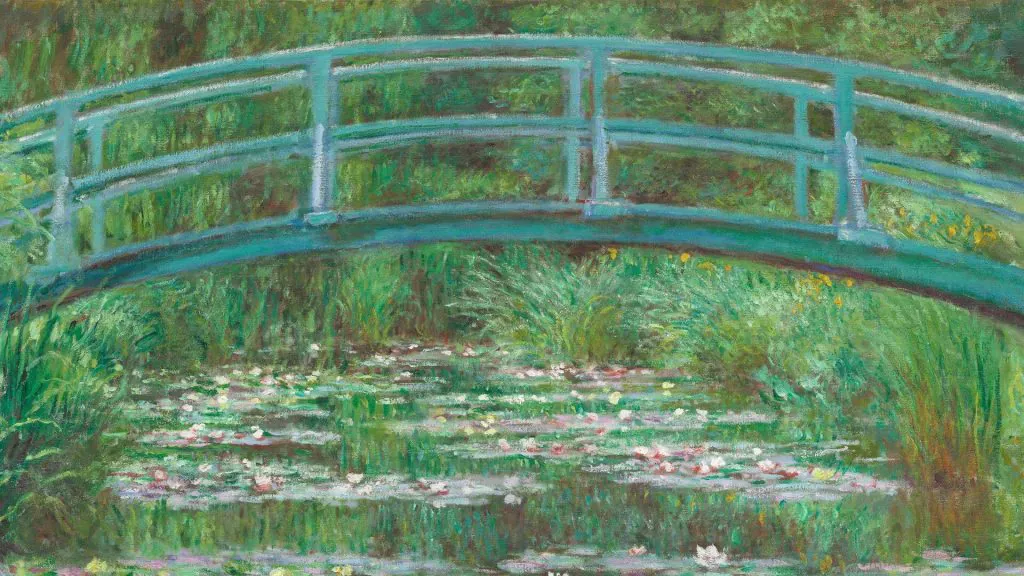
Monet eschewed precise detail and explored the effects of air. Monet is best known for his series of oil paintings. His works include Rouen Cathedral at Different Times of the Day or the Bridge over a Pond of Water Lilies at Giverny. His use of color and attention to visual perception influenced later artists, including abstract expressionists such as Mark Rothko and Jackson Pollock.
Paul Cézanne and the Transition to Modernism
Paul Cézanne (1839-1906) bridged the gap between Impressionism and the modernist trends of the 20th century. Unlike the Impressionists of his time, Cézanne sought to give structure and order to his work. As a result, he began experimenting with geometric shapes and fragmented perspectives in his compositions.
His typical technique of simplifying forms can be seen in the work The Card Player (1890-1895). This technique directly influenced the development of Cubism, which is why artists such as Pablo Picasso and Georges Braque consider Cézanne to be a key figure in the development of modern art.
Georges Braque and Cubism
Cubism was one of the most important artistic revolutions of the 20th century, and its founder, Georges Braque (1882-1963), was on a par with Picasso. It was largely inspired by Cézanne, and as a result Braque began to fragment forms and depict objects from multiple angles at once.
Cubism primarily revolutionized painting, but also influenced sculpture, architecture and graphic design. In addition, movements such as Futurism and Constructivism were also inspired by elements of Cubism and adapted them into their own styles. This shows the global influence of the Cubist movement.
Henri Matisse and Fauvism
Henri Matisse (1869-1954) was the most important artist of Fauvism. This movement was characterized by bright colors and expressive brushstrokes. His The Joy of Living (1905-1906) is an example of Fauvism’s ability to prioritize emotion and feeling over realistic representation.
In the last years of his life, Matisse began to use abstraction and decorative design. He created brightly colored paper cutouts that influenced future generations of artists. Modern painters such as David Hockney reflect his concern for visual harmony.
Toulouse-Lautrec and the Art of Reflecting Society
Henri de Toulouse-Lautrec (1864-1901) was a visual chronicler of bohemian life in 19th-century Paris. His posters and paintings captured the energy and nightlife culture of the cabarets of Montmartre. Styles influenced by Japanese art and sculpture can be seen in all his works.
Toulouse-Lautrec broke new ground in graphic design and advertising and was a pioneer of commercial posters and modern illustration.

The Global Impact of French Art
French art not only transformed painting, but also influenced sculpture, fashion, architecture and design. Art movements originating in France spread around the world and inspired artists in the United States, Latin America, and Asia.
Impressionism, for example, had a huge impact on American artists such as Mary Cassatt and Childe Hassam, who adopted and adapted its techniques. In Latin America, painters such as Diego Rivera and Joaquín Torres García incorporated elements of Cubism and Fauvism into their work.
The tradition and heritage of French painters continues to inspire many artists today. Their innovations in color, form and composition were adopted by those seeking new ways of expression.
To summarize
From Impressionism to Cubism, French painters redefined art time and time again. Their bold innovations have left a lasting mark on art history and paved the way for modern and contemporary art. Their legacy will no doubt continue to inspire new generations of artists and art lovers around the world.
